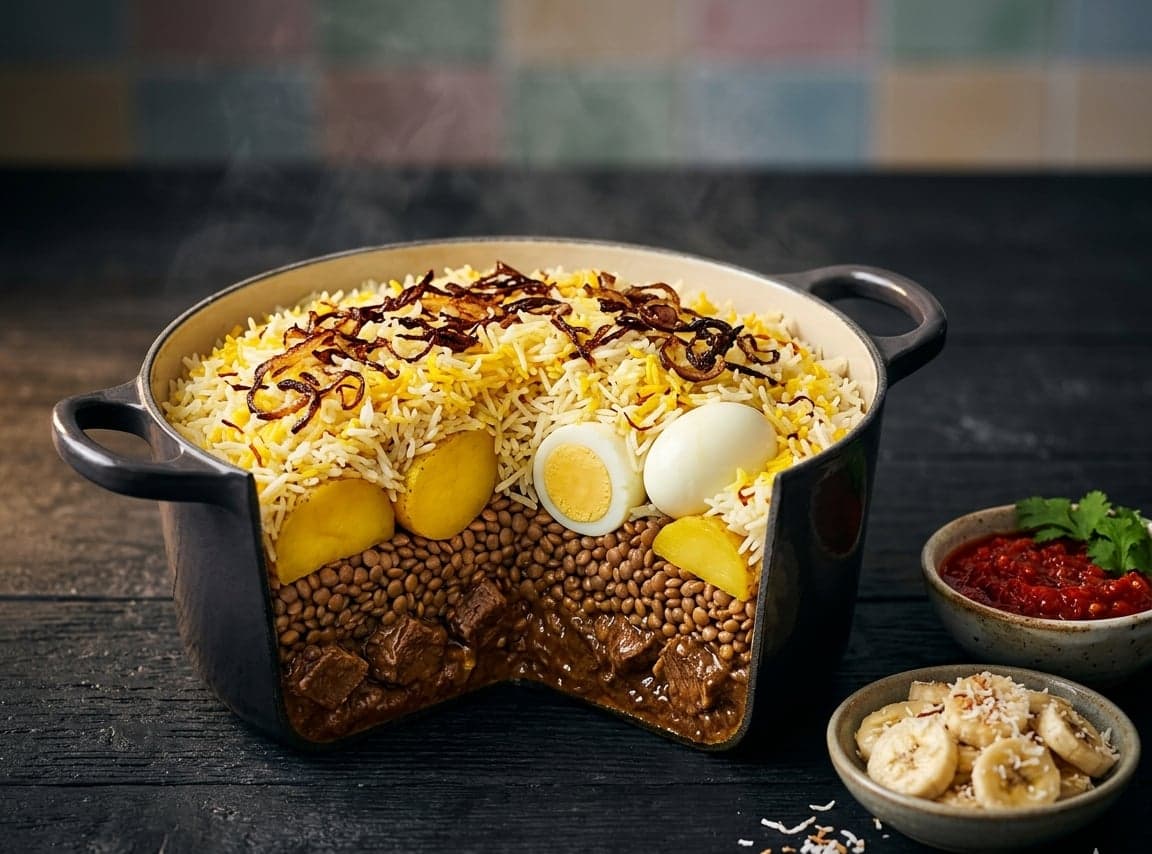
Cape Malay Breyani
The most unique biryani on Earth. Created by enslaved cooks from Java, Bengal, and India in 17th-century Cape Town. The brown lentil layer exists nowhere else in the world.
Where it comes from.
The Cape Malay community descends from enslaved and exiled people from Indonesia, Malaysia, Bengal, Sri Lanka, and the Coromandel Coast, brought to the Cape of Good Hope by the Dutch East India Company (VOC) from 1652 onward. Their breyani — spelled as it is pronounced in Afrikaans — is a creole creation unlike any other: South Asian technique, Dutch colonial spices, Indonesian aromatics, African ingredients.
How to cook it.
- 01
Marinate
Marinate meat for 2+ hours in buttermilk + breyani masala + turmeric + paprika + ginger-garlic + salt.
- 02
Cook the Meat
Brown meat in oil; add grated tomatoes; cook covered until completely tender and the masala is thick and glossy — 40–60 minutes for lamb. The gravy should coat the back of a spoon.
- 03
Prepare the Layers
Cook lentils separately until soft but still holding their shape. Parboil potato halves; brush with turmeric; fry golden. Hard-boil eggs. Par-boil basmati to 70%.
- 04
The Cape Malay Layer Order
Layer from bottom to top in a deep heavy pot: meat with all its thick gravy; brown lentils (this is the signature layer — found nowhere else); fried turmeric-yellow potatoes; whole hard-boiled eggs; half the par-boiled rice; saffron milk; birista; remaining rice; remaining birista; a final drizzle of ghee.
Pro tipThe brown lentil layer is non-negotiable. It is the Cape Malay community's most distinctive identity marker in food. Lentils absorb the meat gravy from below and the rice starch from above — creating a uniquely textured layer.
- 05
Seal & Bake
Cover tightly with foil pressed around the rim, then a heavy lid on top. Bake at 160°C for 45 minutes — or lowest stovetop heat for 30 minutes.
What goes on the plate.
- Sambal (Cape Malay fresh chili sauce)
- Blatjang (fruit-vinegar chutney)
- Sliced banana with desiccated coconut
- Yellow rice on the side
The Cape Malay community's Bo-Kaap neighborhood in Cape Town — famous for its brightly painted pastel houses — was once called the “Malay Quarter.” Breyani is served at every wedding, Eid, Mawlid, and funeral. It is, for this community, as identity-defining as biryani is in Hyderabad.